The first twenty minutes do not have to hold homework, questions, chores and emotional processing all at once. Give arrival one simple shape and let the next step wait.
A useful landing plan is not a reward chart or a rigid sequence. It is a small experiment: choose one arrival cue, offer a few familiar options and notice what leaves the child more available afterward.
Choose one landing path for today
Offer fewer choices than you think you need. The same child may need a different path on different days.
Arrive
Use the same low-pressure cue to mark the shift from school to home.
Meet the body
Check bathroom, temperature, clothing, movement, pain and other immediate physical needs.
Offer fuel
Make a familiar drink or snack easy to access without turning it into another negotiation.
Choose quiet or connection
Offer protected alone time, gentle company or a preferred regulating activity.
Check readiness lightly
After the landing period, ask what feels possible next rather than assuming the plan worked.
“You are home. Food, quiet, movement or company are available. We can talk later.”
Test the routine without demanding perfection
Look for patterns across several ordinary days instead of judging the plan by one difficult afternoon.
Pick a realistic time window
Use twenty minutes as a starting point, not a rule. Some children need less time, more time or a different sequence.
Prepare the environment
Place the chosen snack, comfort item, movement option or quiet space where it can be reached with minimal conversation.
Reduce arrival questions
Save open-ended questions about school until the child shows capacity. Essential safety or schedule information can stay brief and concrete.
Protect age-respectful choice
Tweens and teens may want privacy, headphones, a shower, food or time online. Agree on options together rather than making the routine feel young.
Record only useful observations
Note the option used, visible state before and after, and what came next. Do not turn the log into surveillance.
Adjust one variable
After several days, change one part at a time so the family can tell what helped.
Clear scripts when it is hard to find the words
“You do not have to tell me about school yet. Let’s help your body land first.”
“I can make the first choice for today, or you can point to one.”
“What feels possible next: more time, food, connection or one small task?”
A routine should never hide a bigger concern
Use patterns as information. A consistently difficult transition may deserve support beyond changing the home routine.
Hunger, dehydration, pain, medication effects, illness, toileting needs or sleep loss can change what a child can manage.
Repeated distress tied to a person, place, demand, sensory condition or day of the week can be useful information to document and share appropriately.
Seek appropriate urgent help when a child may be unsafe or expresses intent to harm themselves or someone else.
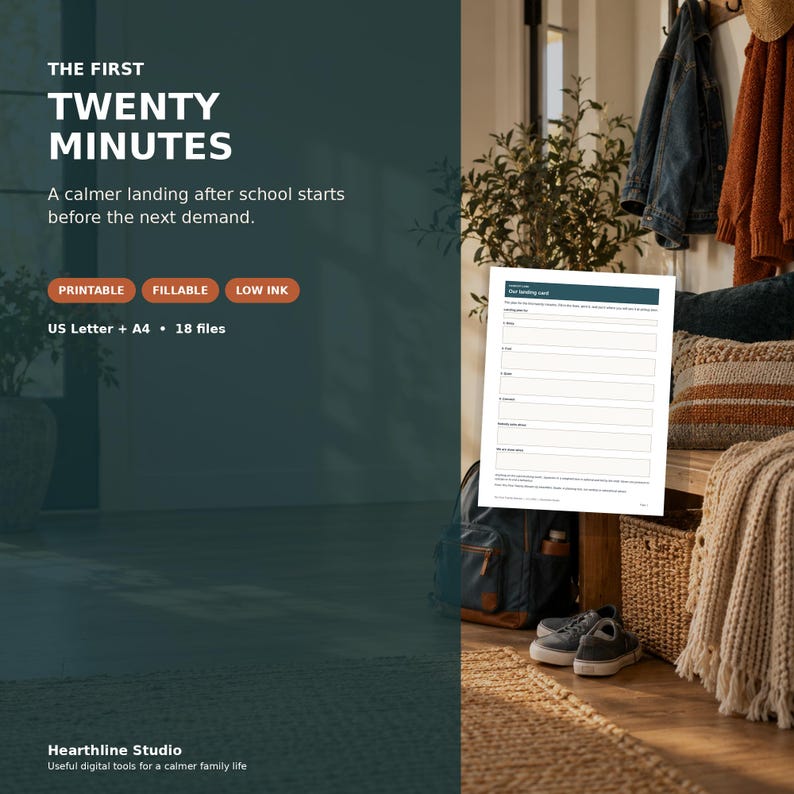
Want the complete plan organized for you?
The First Twenty Minutes organizes the experiment into a 26-page planner with Body, Fuel, Quiet and Connect paths, caregiver handoffs and a ten-day log.
- Printable, fillable and low-ink editions
- Separate age-respectful options for kids, tweens and teens
- Editable Word file and Excel pattern log
Where to learn more
These sources informed the factual and safety guidance in this article. Links open the original organization's page.
Land first. Learn from what happens next.
A good after-school plan gives the family a reliable starting point while leaving room for the child’s needs to change.
Return to the quick-start plan