When a child cannot move toward school, more urgency may create more alarm. The first job is to understand the barrier well enough to choose the next useful bridge.
School refusal is a description of difficulty attending, not a diagnosis or a character judgment. Anxiety, bullying, learning needs, sensory stress, illness, separation fears, social pressure and difficult experiences can all matter. A calm response still needs timely school and professional support when the pattern continues.
Use six steps when the morning is already hard
This is a short decision sequence for the moment. It does not ask you to solve the whole attendance pattern before breakfast.
Stabilize the moment
Slow your pace, lower your voice and reduce the number of people giving instructions.
Check health and safety
Notice acute illness, injury, immediate danger, bullying concerns or a crisis that changes today’s plan.
Use less language
Trade repeated questions and persuasion for one clear sentence and one next choice.
Name the nearest barrier
Is the hardest part getting dressed, leaving home, transport, entering, separating or facing one class?
Choose one bridge
Try the smallest support that moves toward safety and connection, not a perfect morning.
Communicate and record
Tell school what happened plainly, then save pattern-finding for a calmer time.
“I can see that school feels hard this morning. We do not have to solve everything at once. Let’s work out the very next part together.”
Match support to the part that is hard
A bridge is more useful when it is specific. Ask what would make the next five minutes more possible, then involve school in addressing the larger pattern.
Reduce the number of morning decisions
Prepare clothing, food, transport details and comfort items in advance where possible. Use a short visible sequence rather than repeating the full morning plan.
Separate symptoms from assumptions
Headaches, stomachaches, panic, freezing and tearfulness are real experiences even when a medical cause is not found. Avoid treating distress as proof of manipulation.
Identify the exact transition point
A child may manage home but not the car, the gate but not the classroom, or most classes but not one setting. Specific information gives the school something practical to change.
Agree on a receiving adult and place
Ask the school who will meet the child, where they can go and what will happen first. A named adult and predictable entry can make the return less uncertain.
Plan for return after absence
Clarify missed work, arrival, questions from peers, reduced load and where the child can pause. Avoid making the first day back carry every consequence of the days missed.
Review quickly with the right team
Persistent or worsening difficulty deserves early collaboration with school and a pediatrician or qualified mental-health professional. Bring dates, patterns, barriers and what has helped.
Clear scripts when it is hard to find the words
“I believe that this feels hard. Tell me with words, pointing or a number: which part is biggest right now?”
“Would it help to get dressed first or send the school message first? Those are the only two decisions right now.”
“Attendance was not possible today. The main barrier appeared to be entering the building. Please identify one receiving adult and a lower-pressure return point.”
“Tomorrow’s goal is not a perfect day. We know who will meet you, where you will go first and how you can ask for a pause.”
Take repeated school difficulty seriously and early
A morning plan can reduce conflict, but it cannot diagnose or resolve the reason a child is struggling to attend.
Ask about bullying, discrimination, learning difficulty, sensory stress, separation, academic pressure, social experiences, illness and mental-health concerns. The right plan depends on the cause.
When difficulty repeats, contact school and the child’s pediatrician or qualified mental-health professional promptly. Ask for a shared plan with named responsibilities and a review date.
If the child mentions self-harm, suicide, abuse, violence or another immediate danger, follow your local crisis or safeguarding process and contact emergency services when necessary.
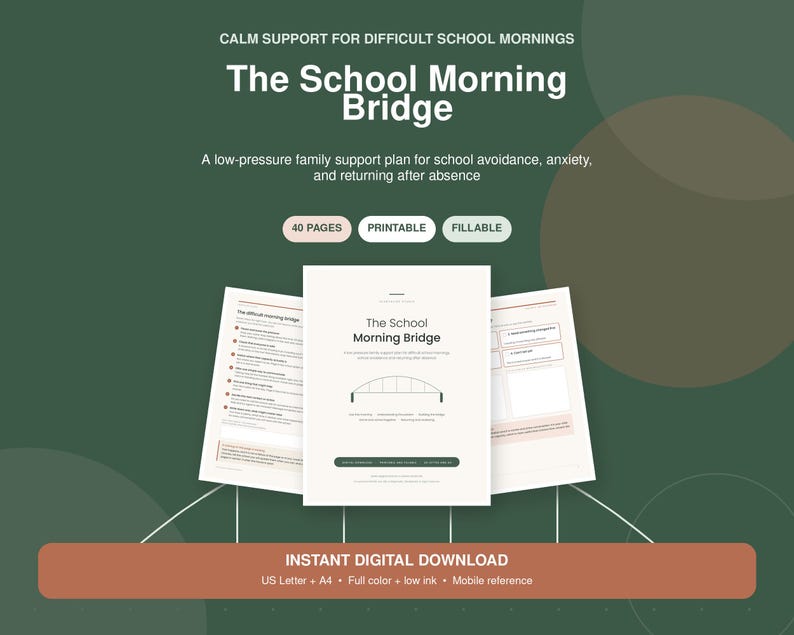
Want the complete plan organized for you?
The School Morning Bridge expands this guide into a 40-page family and school communication toolkit with parent scripts, child and teen cards, return planning and mobile-friendly references.
- Printable, fillable, low-ink and mobile files
- Communication tools for home and school
- Designed without blame or compliance language
Where to learn more
These sources informed the factual and safety guidance in this article. Links open the original organization's page.
The goal is a supported path, not a forced performance.
A useful school-morning plan reduces alarm, identifies the barrier and brings the right adults into the response. Start with the next transition, then build the longer plan from what you learn.
Return to the quick-start plan