A useful child profile does not need to contain every diagnosis, history or difficult moment. It needs to help an adult understand this child and respond more skillfully today.
Families are often asked to explain the same support needs again and again. A short, well-organized profile reduces that burden. It also gives teachers, substitutes, activity leaders and temporary caregivers something concrete to return to when the day is busy.
Strengths-first does not mean minimizing needs. It means beginning with the child as a whole person, then describing communication, sensory differences, stress signals and helpful support in clear, respectful language.
Build the profile around four practical questions
When there is only time for one page, these four questions give an adult a strong starting point without overwhelming them.
Who is this child?
Begin with preferred name, optional pronouns, strengths, interests, sources of pride and the people or activities that matter to them.
How do they communicate?
Include speech, AAC, writing, gestures, movement, visuals and how yes, no, stop, help, wait or unsure may look.
What may adults notice?
Describe calm, early strain and overload in observable terms without judging the child or guessing at intent.
What actually helps?
Name the specific language, sensory changes, pacing, choices, breaks, accommodations and reconnection that support this child.
“Allow about ten seconds for an answer and offer a written choice if speech is harder” is more useful than “needs help communicating.”
Give each detail a reason to be there
The best profile is not the longest. Include information that helps the adult connect, understand, support, protect or communicate.
Strengths, interests and connection
Give the adult an easy way to begin well. A favorite topic, skill, interest or trusted routine can create connection before support is needed.
A short communication summary
Explain how the child usually communicates, how communication may change under stress and how much processing time may be useful.
The most important sensory information
Focus on the sounds, lights, touch, movement, crowds, temperature or internal body signals that are most likely to affect this setting.
Early signs of strain
Help adults notice the quieter signs before overload grows. These may include less speech, more movement, repeated questions, leaving, stillness or seeking familiar input.
Actions that help and actions to avoid
Use short, practical directions such as offer a written choice, reduce language, allow space or avoid public correction and repeated rapid prompting.
Essential safety and contact details
Include only relevant emergency contacts, allergies, supervision needs and emergency communication support. Leave out passwords, identification numbers and unrelated private information.
Write what adults may notice and what may help
Observable descriptions are more respectful and more useful than judgmental conclusions about intent. The same action can communicate different needs in different settings, so leave room for context.
The child turns away, covers their ears or tries to leave.
It may communicate: They may be reducing sensory or social load.
Try: Lower the volume, reduce language, offer a quieter space and keep the exit safely available.
The child repeats a question, phrase or movement.
It may communicate: They may need clarity, predictability, processing time or familiar regulation.
Try: Give one concrete answer, show what happens next and allow the repeated movement when it is safe.
The child becomes very still, quiet or unable to respond.
It may communicate: They may be overloaded or have less access to speech and decision-making.
Try: Reduce demands, wait, offer AAC, writing or simple visuals and do not require eye contact or speech.
The child becomes louder, faster or more physically active.
It may communicate: The situation may be exceeding their current capacity.
Try: Use fewer words, create space, lower nonessential demands and offer a familiar regulation option.
Reduce demands, reduce language, make space and reconnect without shame after the child has had time to recover.
Change the handoff, not the child
Each adult needs a different slice of information. Share what is relevant to that setting instead of handing everyone the complete family record.
Classroom teacher
Prioritize learning access, communication, sensory support, regulation, transitions and current accommodations.
Substitute or guest teacher
Share only the most important same-day information in a format that can be scanned in under two minutes.
Coach, therapist or activity leader
Focus on participation, connection, communication, sensory considerations, breaks and relevant safety information.
Babysitter or temporary caregiver
Include essential routines, food, comfort, regulation, communication, safety and contact details.
Make the adult guidance clear and actionable
Support communication and choice
- Offer two real choices when possible.
- Use clear language and allow processing time.
- Respect “no,” “not yet,” “help” and “break.”
- Accept speech, AAC, writing, gestures and movement.
- Allow safe, harmless ways of self-regulating.
Reduce pressure and shame
- Do not require eye contact.
- Do not repeat prompts rapidly or add unnecessary demands.
- Do not force speech when another communication method works.
- Do not use public correction or shame during distress.
- Do not treat overload as a character problem.
Share thoughtfully and keep the profile current
A substitute may need one concise page. A classroom teacher may need a fuller profile. A babysitter rarely needs school information.
Relevant allergies, contacts, supervision needs and emergency communication support should be current and clearly separated from preferences.
Update the profile after a major transition or whenever communication, health, supports or routines change. A regular family review can help, but it is not a legal requirement.
Do not include passwords, Social Security numbers, identification documents or private history that the supporting adult does not need.
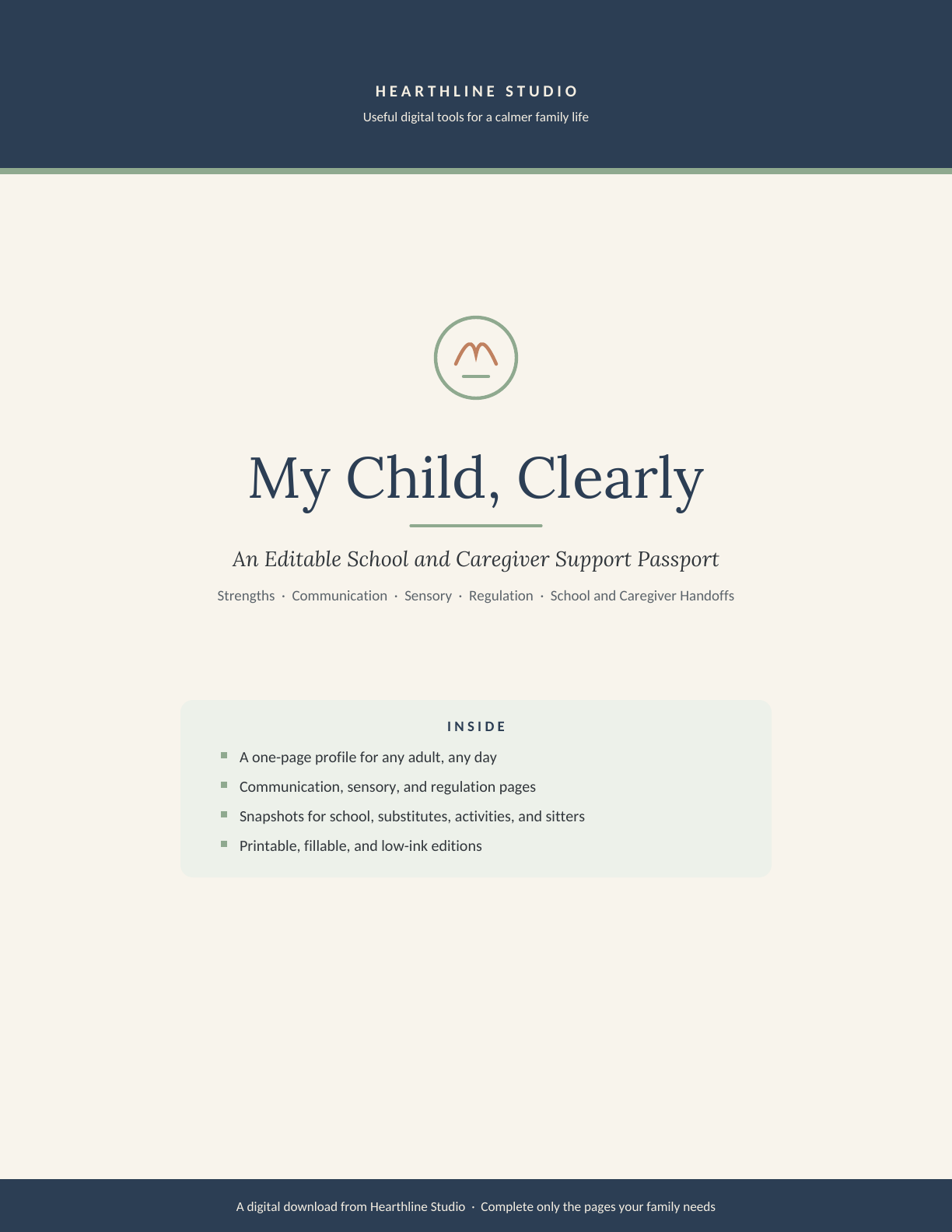
Want the complete handoff system already organized?
My Child, Clearly turns the ideas in this guide into a coordinated 22-page support passport. Start with the one-page profile, then choose only the expanded or setting-specific pages your family needs.
- School, substitute, activity leader and babysitter handoffs
- Printable, fillable, low-ink and editable formats
- US Letter and A4, plus a completed fictional example
Clear support begins with less guessing.
A thoughtful profile cannot predict every day, and it should not try to. Its job is to help an adult notice sooner, understand more accurately and choose a response that protects communication, dignity and safety.
Return to the one-page profile