After school is a transition, not an empty space between school and homework. A child may need food, movement, quiet, connection or time before they can show what they know or tell you what happened.
The aim is not to choose one perfect routine. It is to make arrival predictable while leaving room for the child’s capacity to change from day to day. Sensory load, sustained effort, hunger and difficult moments may all arrive home at once, even when the school day looked successful from the outside.
Use six small steps to make room for landing
Move through these in order, but keep each step brief. On a hard day, the first two or three steps may be enough.
Lower the arrival demands
Pause questions, instructions and decisions for a few minutes. Offer a simple welcome instead.
Meet body needs
Make food, water, bathroom access and comfortable clothing easy to reach without a long conversation.
Offer a landing choice
Let the child choose quiet, movement, company or a familiar interest when possible.
Protect the transition
Use a visible or familiar window of time before checking readiness for the next task.
Check in lightly
Ask one low-pressure question, or observe whether the child is ready for contact at all.
Choose one next step
Decide what is realistic today: homework, a smaller version, asking for help or stopping.
“You do not have to tell me about your day yet. Food is ready, and you can choose quiet, movement or company.”
Keep the anchors predictable and the response adjustable
A useful routine tells the child what is available without requiring the same response every afternoon.
Choose two dependable arrival anchors
Keep simple supports consistent, such as a snack location and a no-questions-first welcome. Predictability can reduce the work of figuring out what happens next.
Create four clearly different landing options
Quiet might be headphones or a dim room. Movement might be walking, swinging or carrying something. Connection might be sitting nearby. Interest might be drawing, building or reading.
Use a signal instead of repeated questions
A timer, card or familiar phrase can mark when you will check in. The signal should invite a decision, not announce that the child must now be ready.
Separate recovery from avoidance
Notice what happens after the landing window. If the child becomes more available, the pause helped. If distress remains high, look for a barrier rather than simply extending demands.
Plan a smaller version of the evening
On lower-capacity days, choose the minimum useful homework step, simplify chores, change the meal plan or contact school. Flexing the plan is information, not failure.
Review patterns during a neutral moment
Later, notice which days, subjects, transitions or sensory conditions are hardest. Invite the child’s perspective and adjust one part of the routine at a time.
Clear scripts when it is hard to find the words
“You do not have to answer questions right now. I am nearby when you want me.”
“Would your body like quiet, movement, company or your own activity first?”
“We can check what your brain has room for in twenty minutes. We will decide together.”
“That was a lot. We can change tonight’s plan without blaming you or pretending it was easy.”
Look for patterns, not just behavior
A decompression routine can support a transition, but it is not a substitute for understanding ongoing distress or getting professional help when needed.
If distress, sleep, appetite, physical complaints, school attendance or daily functioning changes repeatedly, share the pattern with the child’s pediatrician or another qualified professional.
When a child is overwhelmed, use less language, lower sensory input where possible and focus on safety. Problem-solving can wait until the child is more regulated.
If a child may harm themselves or someone else, cannot be kept safe, or faces an immediate danger, contact local emergency services or an appropriate crisis service now.
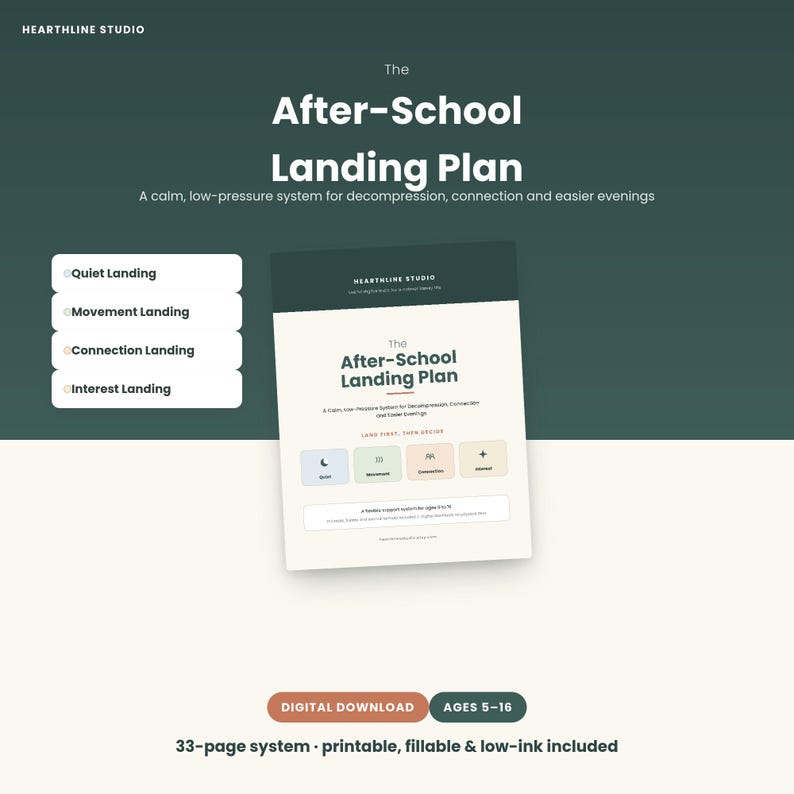
Want the complete plan organized for you?
The After-School Landing Plan expands this guide into a reusable 33-page system with landing options, quick-use tools and separate support for children, tweens and teens.
- Printable, fillable, low-ink, US Letter and A4 files
- Use only the pages that fit today’s capacity
- Designed for decompression, connection and easier evenings
Where to learn more
These sources informed the factual and safety guidance in this article. Links open the original organization's page.
A good landing plan creates room before it asks for more.
The routine can be brief. What matters is that arrival feels understandable, body needs come first and the next demand is chosen with today’s capacity in mind.
Return to the quick-start plan